
Mid-October in Southcentral Alaska has its own feel. Termination dust is creeping down the Chugach, the last birch leaves are letting go, and most of us are thinking more about studded tires than yard signs. A lot of people assume the home search should wait until spring. It does not have to.
Buying in the fall and winter can be a really good fit for some households. You see a home the way you will actually live in it, and you may have a little more room to breathe. This mid-month note is a plain guide to what that looks like here, written for Anchorage, the Valley, and anywhere else the snow settles in for a while.
Why the cold season can work in your favor
Spring brings more listings, but it also brings more buyers. Once school is in and the days get short, the pace usually slows. That can mean:
- Fewer people touring the same homes on the same weekend.
- Sellers who are serious about moving, often for a job, family, or a timeline they cannot change.
- More time to think, ask questions, and look at a home twice.
Every season and every neighborhood is different, so we always look at what is actually happening on the ground before giving advice. Still, a quieter market is often a friendlier one for buyers.
You see the house in its true Alaska season
A home in July can hide a lot. A home in November tells you the truth.
- Notice how warm the rooms feel, especially the ones over the garage or at the far end of the house.
- Look at how the driveway handles snow and whether it slopes toward the street or the garage.
- Watch where ice forms on the roof edge and around entries.
- See how much daylight reaches the main living space. Winter sun sits low, and the direction a house faces matters more here than most places.
If you love a home in the dark and cold months, you will probably love it all year.
Ask about winter costs up front
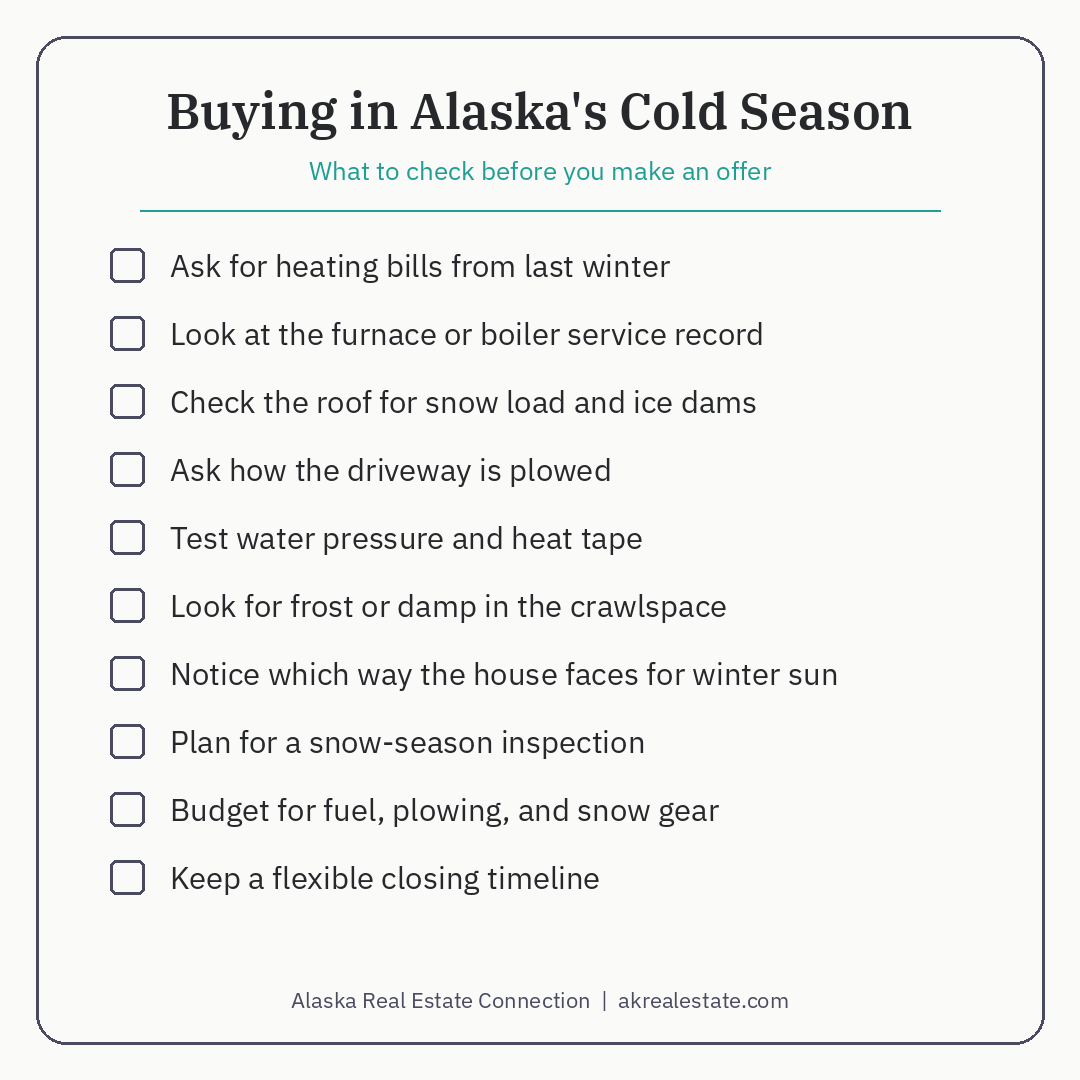
Heating, plowing, and snow care are real line items in an Alaska budget. Before you write an offer, it is fair to ask:
- What did heating cost last winter? A year of utility bills is even better.
- What kind of heat does the home use: natural gas, oil, propane, electric, wood, or a mix?
- When was the furnace or boiler last serviced?
- Is the driveway plowed by a service, a road association, or the owner?
- Is there heat tape on any lines, and does it work?
These answers help you compare homes fairly. A slightly higher price with a newer boiler and a short driveway can be the better deal.
Inspections look a little different in the snow
Snow can cover things an inspector would like to see, like the roof surface, grading, and parts of the foundation. That is normal, and a good inspector will tell you what they could and could not reach.
- Plan a little extra time for the inspection window.
- Ask the inspector to note anything limited by snow or ice.
- Pay close attention to the heating system, plumbing, crawlspace, and attic, since those are easy to check in winter and important to get right.
- Talk with your agent about options if something cannot be seen until spring.
Winter actually makes some problems easier to spot, like drafts, frost in the attic, or a cold spot in the floor.
Keep your timeline flexible
Holidays, travel, and weather can all slow things down from November through January. Lenders, title companies, and movers are busy, and a storm can push back a walk-through.
- Get pre-approved early so you can move when the right home shows up.
- Build a few extra days into your closing date if you can.
- Line up movers and utility transfers well ahead of time.
- Have a backup plan for moving day if the roads get rough.
A little cushion keeps the process calm for everyone.
Pack a showing kit
It sounds small, but it helps. Toss a few things in the car before you head out:
- A good flashlight for crawlspaces and dark corners.
- Boots you can slip on and off at the door.
- A notebook or your phone to jot down room temperatures and questions.
- A warm drink, because some of these showings happen at 4:30 and it will already be dark.
How we can help
Alaska Real Estate Connection is a family-run team, and we have walked a lot of homes in a lot of snow. If you are wondering whether this is a good season for you to buy, we are happy to talk it through with no pressure. We can help you read a home for winter, ask the right questions, and keep your timeline realistic.
Stay warm out there, and enjoy that first good snowfall when it comes.
FROM OUR BLOG

Alaska Fall Home Checklist Before Winter Hits
If you live in Alaska, you already know September does not mess around. The light softens, the birch start to turn, and overnight lows begin to hint at what is coming. Around here, that stretch before freeze-up is one of the kindest gifts of the year for homeowners. It is calm enough to get things d

August 2026: Anchorage inventory up, Mat-Su cools
August told two slightly different stories across the markets we serve. In the Anchorage Municipality, the typical home sold for $490,000, down 2.0% from July's $500,000. Homes that sold spent about 15 days on the market (14.9 in the MLS numbers), 4% faster than July. Buyers had more choices: 435 ac

July 2026: more homes, faster sales, steady prices
July was a busy, pretty straightforward month across both markets we serve. In the Anchorage Municipality, the typical home sold for $500,000, a hair under June's $504,000 (down 0.8%). Homes that sold spent about 16 days on the market (15.6 in the MLS numbers), 7% faster than June. Buyers had more t